


Ep. 2
48:34 min
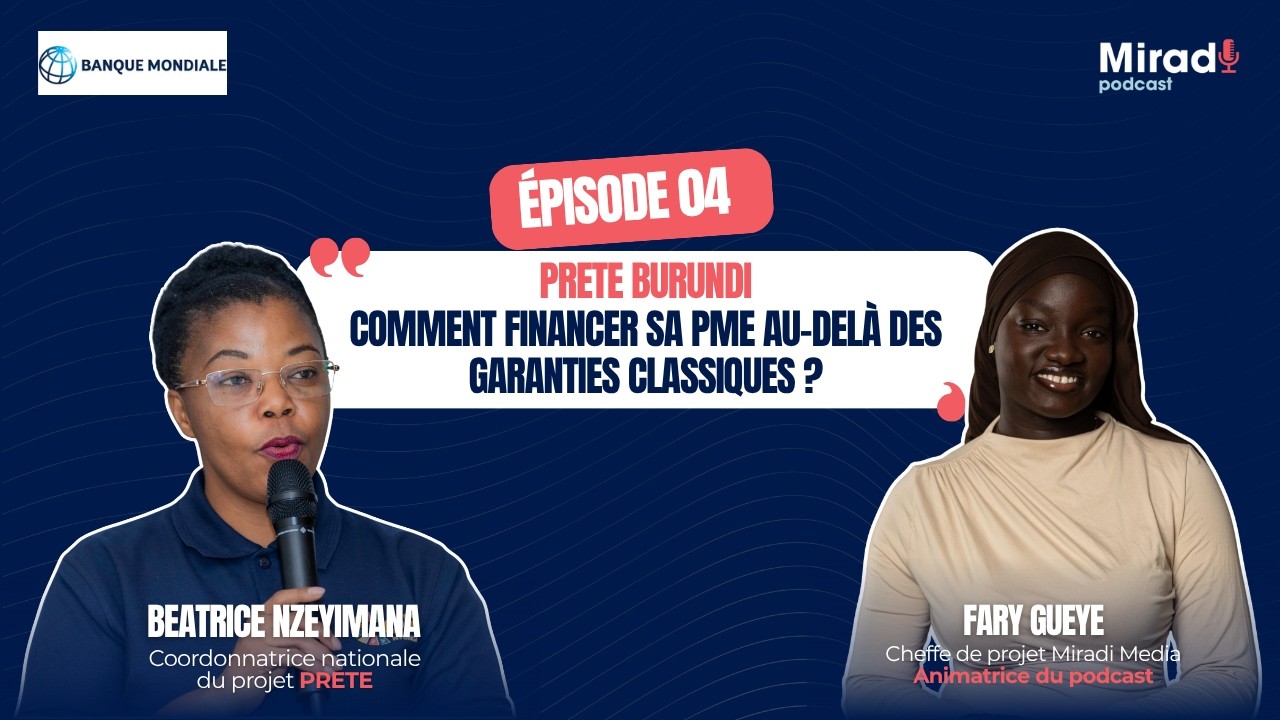
How does a country build a program to transform its private sector and create 22,000 jobs?
In this episode of the Miradi Podcast, we head to Burundi to discover PRETE-The Project for Employment and Economic Transformation, an initiative of the Government of Burundi implemented with the support of the World Bank.
Our guest, Béatrice Nzeyimana, the project's national coordinator, gives us a behind-the-scenes look at a program born from a straightforward diagnosis: limited access to financing, a shortage of foreign currency, struggling competitiveness, and a business climate in need of reform. She explains how PRETE is attempting to address these challenges through a guarantee fund that unlocks credit without traditional mortgages, a future electronic registry of movable assets, business plan competitions targeting SMEs, women, and urban refugees, and support services deployed even in the most remote provinces.
It also discusses some surprising figures.-750 applications received, with 200 expected for the first cohort.-, challenges encountered (identifying refugee beneficiaries, recruiting in time), and lessons that Béatrice Nzeyimana would learn if she were to reproduce this type of program elsewhere.
Listen to the episode on your favorite platforms :
- Spotify : https://open.spotify.com/show/4zyz9tnj7UB1DKI7NXZCfa?si=IaUFVwv5Q7utbfrSo44LvQ
- Apple Podcast : https://podcasts.apple.com/sn/podcast/miradi-media/id1888454496
- Youtube : https://www.youtube.com/@Miradimedia
🔔 Abonnez-vous à Miradi Media pour découvrir d’autres initiatives à impact
LinkedIn : https://www.linkedin.com/showcase/miradi-m%C3%A9dia/
Instagram : https://www.instagram.com/miradi.media?igsh=MXA3eTRmcjVscXQ2Mg==
Visit our website to learn more about African private sector support : https://miradi.media/fr
#MiradiMedia #PRETE #Burundi #Emploi #Transformation #Financement #BanqueMondiale #Worldank #Afrique #Podcast
Fary GUEYE (00:00)
Hello everyone, thank you for joining us on the Miradi Podcast. I'm delighted to be with you today, and especially to take you to Burundi. So, today we're going to the heart of East Africa to discover a program called PRETE. This is the Project for Employment and Economic Transformation, implemented by the World Bank. And to talk about it, we have the pleasure of welcoming the project coordinator. Thank you very much, Ms. Béatrice Nzeyimana, for joining us. I'll let you introduce yourself first.
Beatrice NZEYIMANA (00:32)
Thank you very much. I am Béatrice Nzeyimana, the National Coordinator of the Project for Employment and Economic Transformation. I am a lawyer by training, and before perhaps joining the project, I worked for two years in the judiciary, specifically in the public prosecutor's office—one year as a judge and another as a magistrate. After that, I joined the Investment Promotion Agency (API), which is now the Burundi Development Agency (ADB). At this agency, which is responsible for supporting businesses, investors, and the private sector, I worked for 10 years in various departments, primarily in investor support and guidance, and also in the business registration department. I implemented many reforms within the business registration service, culminating in its digitalization, which is now in use, and the online business creation process. After that, I worked in the department responsible for business climate reforms and human capital development. And that's it. In 2024, I was recruited to coordinate the implementation activities of the Project for Employment and Economic Transformation.
Fary GUEYE (02:31)
That's really interesting. So you have a legal background that I imagine will be very important in your current role. It's fascinating to see that. So today, I'm going to put myself in the shoes of an entrepreneur. Let's say I'm from Ngozi or Bubanza. How exactly does the PRETE program change my life? What do I gain by joining it?
Beatrice NZEYIMANA (02:53)
Yes, so there are many, many opportunities within the PRETE program. First, it's important to understand that the PRETE program is a government project initiated in partnership with the World Bank. It received $50 million in funding from the World Bank to support the Burundian private sector. As an entrepreneur, if you join the program, we have several avenues for support. First, there's direct support for businesses. This direct support is provided, in part, through the Business Plan Competition (COPA). You submit your business plan to receive direct support as an entrepreneur, which includes grants and equipment to modernize or improve your business. Second, there's also the implementation of reforms that help improve access to financing for businesses. This includes the partial loan portfolio guarantee fund that we have just established. So, you can contact your bank and request a loan. If you are eligible for this guarantee fund, you can obtain a loan even without sufficient collateral because part of your loan will be guaranteed by the fund we have just set up as part of the PRETE program. In addition, we are developing an electronic register of movable property security interests. This is an innovation that was not previously available in Burundi and will allow businesses and entrepreneurs to access credit while using movable property as collateral. This was not possible before because, until now, banks and financial institutions have required traditional mortgages, such as property titles or land deeds. With the electronic register of movable property security interests, financial institutions will be able to provide loans to small and micro-enterprises with non-traditional mortgages.
Fary GUEYE (05:30)
Okay, that's an interesting point that I think we'll come back to. We'll discuss it in the second part of this podcast. But perhaps before we go any further, you mentioned that this is a government initiative, this project. And I'd like to know how it actually came about because a diagnostic assessment was conducted on the Burundian private sector. And it's from this assessment, if I understand correctly, that the project was born. Can you tell us more about it? What did you note in this assessment that alerted you and led you to create the PRETE project?
Beatrice NZEYIMANA (06:08)
This assessment was conducted by the government with technical and financial support from the World Bank. The assessment identified several challenges within the private sector. It highlighted the problems faced by businesses, namely limited access to financing and credit. There were also, and still are, problems accessing foreign currency for most businesses. There were also issues with market access and the competitiveness of Burundian companies. Other problems related to reforms—the lack of reforms, the inadequacy of reforms to improve the business climate—including legal and institutional reforms, were also identified. It is on the basis of all these challenges that we prepared the Project for Employment and Economic Transformation. When I say we prepared it, it's because I worked at the Burundi Development Agency, and it was the Burundi Development Agency that prepared the project in collaboration with the World Bank. So, the Burundi Development Agency represents the Burundian government in the project's implementation.
Fary GUEYE (07:41)
Your legal expertise was very important in the creation of this project. So, if I understand correctly, different parts of the government, different government bodies, or Burundian public agencies were mobilized to create and implement this project. But how does the day-to-day coordination work?
Beatrice NZEYIMANA (08:07)
In terms of the project's institutional framework, the project is managed on a daily basis by a dedicated management unit within the Burundi Development Agency. This agency is responsible for promoting investment, supporting investors, and assisting with business creation and development. Therefore, it was, I would say, the most appropriate agency to manage this project, given that its usual mission is to act as the public actor in the private sector. There are a number of services that support the private sector. Even though the management unit is housed within the Burundi Development Agency, it operates autonomously and independently in managing the program. The management unit interacts with other institutions involved in private sector development, notably the Federal Chamber of Commerce and Industry of Burundi, which is, I would say, the legal representative of the private sector in Burundi. There are also other institutions involved. We also collaborate with the Ministry of Justice regarding commercial law. The commercial court itself—I could come back to that in the context of improving the business climate—but there are also other institutions involved, such as the Ministry of Agriculture, Trade and Industry, within its remit, and a multitude of other public and private institutions.
Fary GUEYE (10:18)
Thank you very much, this also helps me better understand who is involved in this project. And perhaps now I'll talk more about the sectors you're highlighting, because in this assessment, I imagine there are sectors you've identified as the most urgent to improve or stimulate. So, if I understand correctly, the poultry sector, the fruit sector, fish farming, mining, and dairy are industries you're emphasizing. I was wondering why you chose these industries, given that Burundi is historically known for coffee and tea production. So, why did you make these choices regarding these other sectors?
Beatrice NZEYIMANA (11:06)
Thank you very much. Yes, Burundi is known as a coffee and tea exporter, but these are priority sectors, I would say, classic priority sectors for Burundi. However, after a while, we realized that these classic priority sectors weren't enough to develop the private sector or to make the private sector the engine of development. So, we relied on coffee and tea for a long time, and these sectors contribute to the country's development, but we've also seen over time the emergence of other potentially impactful sectors that could contribute to economic development, the transformation of the country, and job creation. Currently, the world is facing the challenge of creating jobs for young people.
Fary GUEYE (12:08)
I understand perfectly, and perhaps to delve a little deeper into the program, I'd like to know, today you aim to support and finance 1,600 MSMEs (small and medium-sized enterprises), with a focus on women and refugees. I'd like to know how you guarantee that it won't just be the same businesses or the same people participating in your program, but that everyone, whether I'm in Bubanza or Kirundo, will still have access to it.
Beatrice NZEYIMANA (12:41)
Yes, we must guarantee fairness and inclusion in the implementation of this program. We have put in place mechanisms and measures for the integration of priority beneficiaries, as you mentioned, namely women and refugees. Women have a quota of 50% of the beneficiaries, and refugees 6%, in the implementation of the project's activities. So, for example, what has already begun is the business plan competition to award grants to micro, small, and medium-sized enterprises. We launched an awareness campaign throughout the country. We traveled to all the provinces. We raised awareness among all entrepreneurs. We also informed women. We are working through formal women's entrepreneurship organizations. We also met with representatives or organizations that work with refugees to inform them of the opportunity and to mobilize refugees. Here, when we talk about refugees, we are referring primarily to urban refugees who carry out income-generating activities.
Fary GUEYE (14:13)
Okay, very clear. So, for these refugees, how do you manage to convince the banks or the FIGA (the Guarantee Fund) to lend certain sums to a project that is still fragile or a project that has just started?
Beatrice NZEYIMANA (14:33)
Yes, a project that has just begun can have a significant impact. In the life of a business, there are activities, there are projects that are initiated, and some succeed, but some do not. It's like a person's life; it's a business, and it has an end. So, a project that has just begun can have a significant impact. We also rely on the expertise of banks in analyzing loan applications. That's why we've established a guarantee fund managed by FIGA, but the loans are granted by banks and microfinance institutions. So it's the same process, the usual loan approval process, the analysis of loan applications, but the fund simply supports the institutions when they find that an entrepreneur has a profitable, impactful project, but lacks sufficient collateral. This is where the Guarantee Fund will intervene to allow this entrepreneur to develop his business, even if he does not have sufficient mortgages.
Fary GUEYE (15:54)
Okay. So, this is a type of communication you also use during calls for participation campaigns. Because I don't know if refugees or entrepreneurs are even aware that these mechanisms exist? So, in your communication with these potential participating companies, do you highlight this?
Beatrice NZEYIMANA (16:21)
Yes, that's right, we're running awareness campaigns, and not just for newly launched projects, because the beneficiaries include both formal and informal businesses. So, we're raising awareness even among those working in the informal sector. These businesses and activities are eligible for the PRETE program. Therefore, we're trying to make everyone aware of these opportunities.
Fary GUEYE (16:49)
Okay, but how does the selection process work? As the coordinator, how do you ultimately assess who is eligible for the program and who isn't? Do you consider your criteria to be rigid or not really?
Beatrice NZEYIMANA (17:02)
We just launched the first cohort. The project is in its initial phase. We launched the first phase, and initially, we expected to receive a maximum of 200 applicants, 200 candidates seeking support. But we ended up with over 750. So, that's just the first phase already, and we've had over 750. Currently, the team of experts assisting us in organizing this COPA (Competitive Business Development Program) is working on the pre-selection process. They're reviewing eligibility. We'll receive the pre-selection report later this week. And fortunately, we've also planned a training and support program to help develop the business plans that will be submitted to the competition. So now we're pre-selecting the candidates. We'll pre-select those who, based on the criteria we've established, are eligible. Then we will organize training for them, providing support in business management and the development of bankable business plans. Afterwards, they will submit their well-developed projects, and we will select the projects that will receive subsidies under this COPA program.
Fary GUEYE (18:47)
Okay, that's very clear. So, what are the criteria, just for those of you listening who might want to participate? Is it based on the number of years the organization has been in existence? Could you elaborate?
Beatrice NZEYIMANA (19:01)
The first criterion is to be a Burundian company. That's the first criterion. If you have a company registered under Burundian law, even if you are Senegalese, you can participate. The second criterion—there are quite a few criteria, but the second is to have been in existence for at least one year. Whether it's a formal or informal existence, you must have been in existence for at least one year.
Fary GUEYE (19:47)
But for an informal business, what proof does it show you of a year's activity?
Beatrice NZEYIMANA (19:55)
A certificate of recognition from the local administration is required.
Fary GUEYE (20:00)
Okay. Is it difficult to obtain or not?
Beatrice NZEYIMANA (20:02)
No, it's not complicated. Normally, at the local administration level, at the zone level, anyone who starts a business is known to the local administration and can apply for this certificate at the zone level. We've seen that many people have obtained this certificate. It's not complicated. There is one document we required that was perhaps not very easy to obtain: a criminal record check. This certificate proves that you are not being prosecuted by the Burundian justice system, that you are not among those who have committed criminal offenses. But we also found a flexible mechanism. We allowed people to apply during the deadlines and then complete their application with this criminal record check certificate afterward.
Fary GUEYE (21:08)
Okay, that's important.
Beatrice NZEYIMANA (21:10)
It is still required, but it can be submitted after the other elements.
Fary GUEYE (21:16)
Okay, that's true. So that's a good alternative for those who don't receive their documents on time. And do you also have a geographical focus for the Burundian territorial coverage, any representation targets or quotas you've set? No? Okay.
Beatrice NZEYIMANA (21:36)
No. The project covers the entire territory.
Fary GUEYE (21:41)
Okay, but how do you ensure that it's not just people from Bujumbura or Ngozi who come?
Beatrice NZEYIMANA (21:51)
We launched the COPA initiative first, starting in Bujumbura to inform the public and entrepreneurs, and then we organized outreach programs in all the provinces. We set up relay stations in the provinces to support the population because applications are submitted online via an electronic platform. We know that there are people in the interior of the country who lack the skills to apply. Even though we made the platform available in the national language, Kirundi, we know that some entrepreneurs may not be comfortable using computers to apply. That's why we set up relay stations in the provinces to help people apply.
Fary GUEYE (23:00)
This allows me to transition to your projections and perspectives for this program. If I understand correctly, the objective is to create many jobs by 2028. I think we're at the level of 22,000 jobs you've set for 2028, but how do you measure this job creation within the framework of the project?
Beatrice NZEYIMANA (23:26)
We will measure the creation of these jobs because there are mechanisms we are putting in place that will enable this job creation. Firstly, these are the companies that will be supported and will benefit from subsidies. What I can emphasize is that we have three types of subsidies. We just mentioned COPA. This is one of the three types of subsidies we will implement. And COPA aims to reach more than 600 companies. So that's one category of subsidies. We also have other subsidies that we call cost-shared subsidies. These will be subsidies for productive infrastructure. And the average subsidy is $250,000. This is really to subsidize productive infrastructure that will contribute to the development of value chains. These are shared infrastructures whose beneficiaries are more than one company. And then there will also be the other category of subsidy, which is the performance subsidy, designed to support businesses in building relationships with suppliers and buyers. This will enable Burundian businesses to meet the standards required by buyers. When we talk about buyers, we're also talking about the market, whether it's the national, regional, or even international market. So, through all this support that we will be deploying, which in fact constitutes almost half of the project's budget, the underlying budget is $48 million. You understand that this is almost half of the project's portfolio. We intend to reach these businesses directly, and it is through these supported businesses that we will be able to identify the jobs that will be created by these supported businesses, based on the project's interventions. Because in the business plans that entrepreneurs will submit to benefit from the subsidies, they will indicate the jobs they will create. We have experienced teams to analyze the business plans and the profitability of the projects. Regarding project profitability, job creation is also a key component. It's through this mechanism that we can monitor and track job creation. That's one aspect. I mentioned that, secondly, we support access to credit. There's also the establishment of a guarantee fund. This is one of the tools to facilitate access to credit. In loan applications, they also detail the profitability of the project for which they are requesting funding. And there, we can also identify the jobs that will be created through these projects implemented with the support of these loans. Furthermore, we are developing an electronic register of security interests in movable property. This is another tool, another mechanism that will allow businesses to create jobs. We have several mechanisms that will allow us, at the end of the project, to identify the jobs created as a result of the project's interventions.
Fary GUEYE (27:51)
I'm wondering, as coordinator today, you must have a lot to keep track of, I imagine. But how does it all work in practice? Because you're talking about guarantee funds, access to financing, and job creation. How do you actually go about it?
Beatrice NZEYIMANA (28:10)
I don't work alone. I'm the coordinator, but I don't work alone. I have a whole team we work with. There are the experts from the project management unit. There are the consultants who support the project management unit. There are the grant management firms that also work with us, assisting us in the selection and support of grant recipients. But there's also FIGA, which is a separate institution that will manage the guarantee fund. So, I would say we've outsourced certain services, certain activities that are managed by other organizations. But the project management unit coordinates and monitors the other service providers and the other managers of certain project programs.
Fary GUEYE (29:09)
Yes, absolutely. And perhaps one last question about job creation: how do you ensure that at the end of the funding period, in 2028, at the end of the project, a job created within this framework doesn't disappear when the project ends? How can we be sure they will be sustainable?
Beatrice NZEYIMANA (29:37)
We are also putting in place mechanisms to ensure the sustainability of our achievements. A project that is being implemented must also consider the long-term viability of its actions. We are working with the Burundi Development Agency and are currently strengthening this agency so that, at the end of the project, it can continue to monitor and support the beneficiary businesses.
Fary GUEYE (30:12)
Now, if we also turn to the question of beneficiaries, you mentioned earlier a 6% quota, meaning the inclusion of priority beneficiaries, namely refugees. What does this really change in the design, and what obstacles did you perhaps have to overcome to truly integrate them?
Beatrice NZEYIMANA (30:35)
The first challenge we faced initially was identifying the refugees. Our target group is refugees who are engaged in income-generating activities. We commonly refer to them as urban refugees. This doesn't necessarily include refugees in refugee camps, but also many refugees in various cities across the country who have integrated and are also running income-generating businesses. To identify them, we worked with ONPRA, the National Office for Refugee Support. We also worked with the IOM, which also assists refugees and supported us in identifying the intervention areas for these refugees. We already have the areas where most refugees are located in our database, and we meet with them there to raise awareness and encourage them to apply to work with other businesses. And since we have just implemented the first phase, we will analyze the results of the first phase and adjust the mechanisms for the next phases in order to also reach the target of the project.
Fary GUEYE (32:17)
So that was one of the challenges you encountered in identifying those beneficiaries. Did you encounter others? How long has the project been running?
Beatrice NZEYIMANA (32:29)
Yes, the project started in March 2024. The project came into effect in March 2024. It's been a while.
Fary GUEYE (32:39)
Okay, so from March until now. Have you experienced any other challenges?
Beatrice NZEYIMANA (32:49)
No, really, because there are professional organizations for women, and there's the Women Entrepreneurs Association with which we work. And then, personally, I worked for a long time at the Investment Promotion Agency. I worked for a long time in the business creation department. So, even if we access the database of companies created at the Burundi Development Agency, we can easily find our target. So it's not complicated. And besides, Burundi isn't a large country, so information travels very quickly.
Fary GUEYE (33:31)
And perhaps another question I had was regarding the green and digital sectors. Are there any incentives you offer companies today to move towards these sectors? Do you promote them? So, all things green technology, so that companies don't see it as an obstacle, but also as a business opportunity. Is that one of the points you emphasize?
Beatrice NZEYIMANA (34:05)
Yes, yes, it's one of the project's priorities, and it's also one of the government's priorities. The Burundian government is promoting digital technology and digitalization. They're first promoting the digitalization of their services and encouraging people to work with new information and communication technologies. It's a real opportunity, I would say, for the project because we aim to support ICT and digital technology, and the government is also promoting this. It's a coincidence that gives us a very easy platform for action.
Fary GUEYE (34:57)
Is it through masterclasses, conferences, how do you also go about raising awareness on this subject?
Beatrice NZEYIMANA (35:08)
We organize conferences and programs on national media. And since we also have many partners and institutions we work with, there are separate activities we carry out with them. And most of the time, these activities—workshops, conferences, and so on—are publicized.
Fary GUEYE (35:41)
Okay, perfect. So there's good media coverage, which is helping to democratize this information. Now, for the companies listening, how can they join this program? We talked about the criteria earlier, but what are the concrete steps in the selection process? And how long do they have to apply and hope to participate in this program?
Beatrice NZEYIMANA (36:05)
Okay. I'll start with participation in the partial loan portfolio guarantee fund. This guarantee fund, managed by FIGA, guarantees the loans that financial institutions have granted to businesses. So, businesses will apply for these loans through their usual bank. It's not complicated. It doesn't require any particular effort. A company with a project—and businesses generally work with the financial sector—we've informed companies and banks that, to date, work with FIGA and collaborate with it. For this first phase, we already have four participating banks, but we're also selecting others that have expressed interest in becoming financial institutions participating in the guarantee fund. That's what we call them. You understand that it doesn't require much effort; we don't have to go looking for companies to inform them about this guarantee. We simply say, "Here's the fund." If you have a project, if you have a business to run and you lack funding, approach your usual bank. Here are the banks and financial institutions that are already eligible. Approach them, submit your projects. The projects will be analyzed by these institutions, and you will benefit from a loan partially guaranteed by the loan portfolio—a silent guarantee. So the beneficiary doesn't need to know who provided it. That's why we work with the government to prevent beneficiaries from thinking, "Well, my loan benefited from the support of the government guarantee fund, I don't owe anything, I don't have to repay." We want businesses to repay the loans so that the guarantee fund can also support as many entrepreneurs as possible who apply for loans in the same situation. That's one way we do it. And then, for direct support, as I mentioned earlier, we publicize the information; we organize outreach programs in the provinces. We inform people, we provide the link to the platform, and we also inform them that there are cell towers in the provinces. Even if, for example, the signal is weak, we emphasize the presence of the cell towers. Entrepreneurs can approach our cell towers in the provinces, and they will help them access the platform. We launched this call for applications. The first phase closed on April 6th. We are currently making the initial selection. After that, we will relaunch it. We will reopen the platform so that others can submit their applications. We will communicate this again when it reopens. As I said, we expected at least 200 applicants in the first phase. We had over 750.
Fary GUEYE (39:46)
No, honestly, that's good.
Beatrice NZEYIMANA (39:49)
Initially, we planned to do six cohorts, but if people apply at this rate, we will certainly do three cohorts per year.
Fary GUEYE (39:58)
Yes, no, I imagine so. But it's a very positive sign for you because it shows that the information is reaching the right people, but also that people are interested and that the need you're addressing is a priority; it's validated. It's really a very good sign. If there are still two years left before the end of the program, it already gives a good indication of the program's success. That's really good. And so today, in your role as project coordinator, if we were to replicate PRETE, let's say in another fragile ecosystem, what advice would you give to one of your colleagues starting this project?
Beatrice NZEYIMANA (40:51)
My advice would be to prepare the tools or put the prerequisites in place on time. Because even we are slightly behind schedule. We've experienced a slight delay. For a project or program that's just starting, this would maximize the chances of successful implementation. It would be better to put the prerequisites in place on time. When I say "on-time prerequisites," I'm referring first and foremost to recruiting the project management team. Don't wait until the project is officially launched to recruit the management unit, but put it in place, because that's what happened to us. So, the management unit was put in place after the project was already in place, and it takes time to actually implement the project activities. If we could put the management unit in place before the project was launched, that would be ideal. And initially, the prerequisite for us was to conduct a value chain analysis. You mentioned earlier the value chains we will be supporting. First, we needed to conduct a diagnostic assessment of these value chains to identify the challenges and the productive infrastructure needed to develop them. This is part of the prerequisites that can be completed even before the project is implemented. So, if we were to implement the same program in a similar context to Burundi, I would advise that these prerequisites be put in place in a timely manner, that grant management firms be recruited promptly, and that grants be awarded throughout the project's lifespan, allowing time to evaluate the project's impact. That's what I would advise. Thank you.
Fary GUEYE (43:02)
So, perhaps to move towards the conclusion, what is the future of the project? Do you want it to remain anchored in the Burundian economy, even after the World Bank withdraws?
Beatrice NZEYIMANA (43:16)
What will remain after the project is, first and foremost, the positive impact of this guarantee fund, because we are guaranteeing loans to implement or develop business activities. And the loans we guarantee are sometimes medium-term loans. They aren't repayable in one year; often it's over two, three, or even five years. So, that will remain even after the project. Secondly, the productive infrastructure we will put in place to develop value chains will also remain, and we are working with the Burundi Development Agency so that it can take over after the project and continue to monitor, as is part of its mission, the Burundian investors and entrepreneurs who have benefited from the project's support. The agency can continue to monitor and guide them. And there, in its missions, the guidance, support, and assistance of investors—as we also work for the Development Agency—this is an institution that will not close with the project, but will continue to support and assist the entrepreneurs who have benefited from the project's support. And of course, if possible, the government can also request further support from the World Bank, because I cannot say that our support will be entirely sufficient, considering the needs expressed during the pilot phase. There will also be other programs that will continue to support the Burundian private sector, Burundian businesses, to enable them to grow, create jobs, and contribute to the transformation of the national economy.
Fary GUEYE (45:34)
That's a wonderful conclusion, a truly excellent conclusion, both regarding the program itself and this exchange, because, as you mentioned, it's precisely these initiatives, all these mechanisms that you're putting in place, that are what we aim for with this type of program. So I'm very pleased to have had the opportunity to speak with you, to have gained a better understanding of the PRETE program, but also to see how it's being implemented in practice in Burundi, to learn about the different stakeholders, how entrepreneurs can join you, and especially to understand your role as coordinator and what you do within this program. Thank you very much, Ms. Béatrice Nzeyimana. It was a very fruitful and enriching exchange for me, and I hope for those listening as well. I'll let you have the last word. Do you have any final thoughts?
Beatrice NZEYIMANA (46:29)
Thank you as well, Fary Gueye. Thank you for the opportunity, and thank you for the discussion. I remain available, even in the future, should you need to discuss the PRETE project further. Thank you.
Fary GUEYE (46:48)
Thank you so much, my pleasure. In any case, I'm eager to see what indicators you'll present at the end of this project, which already promises a positive outcome. I hope it continues this way. And to our dear listeners, thank you for following us. We'll see you very soon on Miradi Podcast. Until then!
Beatrice NZEYIMANA (47:08)
See you soon !