


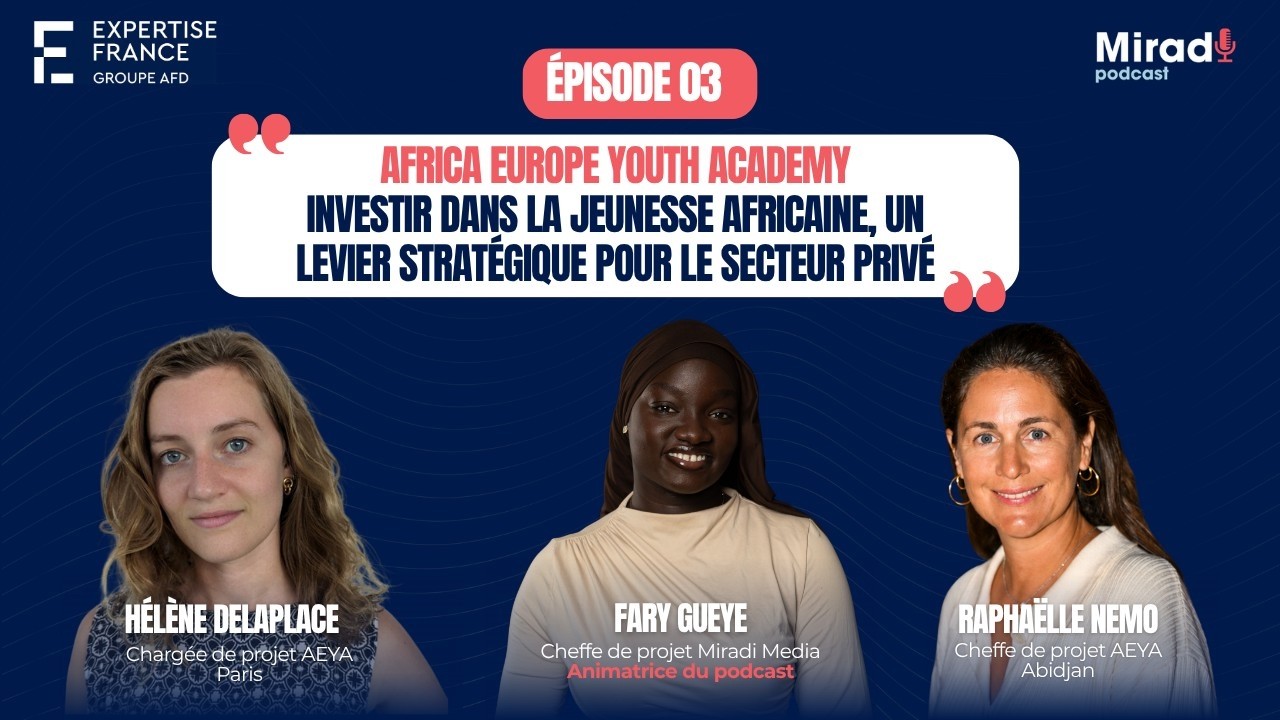
Ep. 3
53:06 min

In this episode of our podcast, we welcomeLivia Sossou, lead technical advisor of the BeDigital program, to discuss the challenges of digital transformation in Benin and the role of digital technology as a lever for inclusive development.
Through BeDigital, a program funded by Luxembourg Cooperation and implemented by LuxDev, the objective is to strengthen the Beninese digital ecosystem by supporting innovation, entrepreneurship, cybersecurity and access to digital services.
Faced with the challenges related to digital inclusion and the accessibility of digital services, the program offers an approach rooted in local realities, supporting startups, SMEs, public structures and young digital talents.
Fary GUEYE (00:00.0)
Good morning
Fary GUEYE (00:00.467)
Hello everyone, thank you for joining us
Livia Sossou (00:00.863)
Hello everyone, thank you for...
Fary GUEYE (00:02.5)
development.
Fary GUEYE (00:02.504)
Development. This podcast takes you on a journey to discover private sector support programs in Africa. Today, we're fortunate to have Livia Sossou with us to discuss a program called BeDigital, implemented by Luxembourg Cooperation in Benin. So, hello Livia, thank you for joining us.
Livia Sossou (00:02.863)
The podcast that takes you on a journey to discover private sector support programs in Africa. Today, we're fortunate to have Livia Sossou with us to talk about a program called Vigitale, implemented by Luxembourg Cooperation in Benin. So, hello Livia, thank you for joining us.
Livia Sossou (00:21.683)
Hello Fary, with pleasure, thank you for the opportunity. My pleasure. Before continuing, I'll leave you
Fary GUEYE (00:25.136)
With pleasure. Perhaps before we continue, I'll let you introduce yourself.
Livia Sossou (00:28.737)
introduce,
Fary GUEYE (00:28.842)
to present,
Livia Sossou (00:28.842)
introduce,
Fary GUEYE (00:28.886)
to present,
Livia Sossou (00:28.886)
Introduce yourself, tell us more about your role within this program and give us more details about where you are today.
Fary GUEYE (00:29.092)
Tell us more about your role in this program and give us more details about where you are today.
Livia Sossou (00:36.023)
Livia Sossou (00:36.87)
Great, thanks Fary! As you said, I'm the lead technical advisor for the Bidigital program, which is the digital program funded by Luxembourg Cooperation in Benin and implemented by Luxdev, the Luxembourg development cooperation agency. My specific role in the program is to oversee its technical implementation. I coordinate the various partners, both technical and institutional, who are working on the different objectives. I also ensure consistency.
Livia Sossou (01:06.974)
components of the program and knowing that the ultimate goal is therefore that the digital solutions being developed will truly meet the needs of the beneficiaries, who are ultimately the entire Luxembourg population, therefore all citizens, but also, of course, in particular entrepreneurs and SMEs.
Fary GUEYE (01:27.361)
Yes, to you.
Fary GUEYE (01:29.241)
Thank you for giving us so much information about this program. We're eager to learn more. But looking back on your career, how do you see the digital ecosystem in Benin today?
Livia Sossou (01:29.636)
Already, the pressure to give us enough information about this program is mounting; we're eager to learn more. But then, with a bit more perspective on your career goals, how do you see the digital ecosystem today?
Livia Sossou (01:41.111)
Benin? It's true that Benin has made remarkable progress in the digital sector, whether in terms of governance, infrastructure, or digitized public services. It's been exactly 10 years today, since 2016, thanks to the will
Livia Sossou (01:59.69)
The government has defined a very clear strategy in the digital sector, so it's quite impressive today, after ten years, to see how far we've come and the ambitious reforms that have been decided upon. The state has truly played the leading role in this evolution, while the private sector has also been able to contribute through skills development and the development of solutions. It's true that a real challenge remains.
Livia Sossou (02:29.47)
In the adoption and appropriation of digital technology by end users in general, but also by the private sector, SMEs, and in the dissemination of digital culture throughout the country, significant progress has already been made. The challenge, I believe, over the next ten years, will truly be widespread adoption so that this maturity progresses at all levels and, above all, across the entire territory.
Fary GUEYE (02:57.825)
Yes, absolutely. And right away, behind this question of the maturity and growth of the digital sector in Benin, there is of course a strategic choice made by Luxembourg's digital cooperation. So, on what aspect was this choice based? What factors led the cooperation to decide? Okay, we're going to invest in the digital sector in Benin.
Livia Sossou (02:58.176)
Yes, absolutely. And behind this question of the maturity and presence of the digital sector in Benin, there is, of course, a strategic choice made by Luxembourg Cooperation regarding digital technology. So, on what aspect was this choice based? What were the driving forces behind this decision? Okay, so we are going to invest in the digital sector in
Livia Sossou (03:25.056)
Benin.
Livia Sossou (03:28.13)
Luxembourg has a well-recognized expertise in innovation, particularly in digital technology, and especially in cybersecurity. Since this was a priority for Benin, it was a good opportunity. Generally speaking, in Luxembourg's partner countries, digital technology is always a cross-cutting lever integrated into various programs. These programs can be related to employment, education, or health. Digital technology is used as a tool. However, this is truly the first time that Luxembourg cooperation has undertaken such a project.
Fary GUEYE (03:33.409)
...
Livia Sossou (03:58.05)
which is 100% digital in Benin, and this allows us to use digital technology as a cross-cutting tool for other sectors. Here in particular, we have targeted the inclusive and innovative finance sector and the technical and vocational training sector because these are sectors in which Luxembourg has a priority in Benin. But it also allows us, in addition to this aspect of digitalization, to address needs specifically within the digital sector.
Livia Sossou (04:28.39)
Because we're ultimately part of a very strong dynamic, with, as we've said, a reformist government, but also an innovative startup, a rapidly expanding tech ecosystem. So, it's a good opportunity for Luxembourg to contribute its expertise to this ecosystem. Absolutely. Therefore, among your beneficiaries, there's also a strong focus on women entrepreneurs. Could you tell us about the level of maturity required for these women-owned businesses?
Fary GUEYE (04:44.257)
Among your beneficiaries, there is also a large focus on female entrepreneurs. Could you tell us about the maturity required of these women-owned businesses?
Fary GUEYE (04:56.376)
What criteria do you generally use to choose them?
Livia Sossou (04:56.376)
And what criteria do you generally use to base your choice of product?
Livia Sossou (04:59.252)
So, there are several tools that are being used to support women's entrepreneurship. In this regard, we have primarily worked with a local association, Women in Tech.
Livia Sossou (05:14.088)
which aims to strengthen women's entrepreneurship in the digital sector. We supported this association in structuring itself and defining a clear strategy to play an impactful role in the development of women's digital entrepreneurship in Benin. In particular, we are supporting them in implementing the SheGrowth initiative, which is aimed primarily at women who already have a business or a fairly structured project, but who lack access to financing.
Livia Sossou (05:44.102)
who also lack access to digital tools specific to their business and to strategic artistic training. So, for example, here, the program aims to support Women In Tech by implementing truly specific training and coaching on topics related to digital marketing, how to automate their services, and how to improve their business plan in order to accelerate their growth, so that they can better reap the benefits of...
Livia Sossou (06:13.962)
digital value chains and improve their
Livia Sossou (06:16.99)
growth.
Livia Sossou (06:17.479)
Fary GUEYE (06:17.548)
Okay, so for this program,
Fary GUEYE (06:19.86)
It's really about capacity building for acceleration, and access to financing for women-owned businesses.
Livia Sossou (06:19.992)
It's really about capacity building for accelerating access to financing for women-owned businesses.
Livia Sossou (06:26.833)
That's it. So it's technical support, but ultimately, the idea is for them to have better access to funding opportunities and, above all, to grow their revenue. And how many SheGrowth beneficiaries have you had? We have 20. 20 women entrepreneurs who have benefited from this support.
Fary GUEYE (06:28.782)
Yes.
Fary GUEYE (06:36.718)
And how many beneficiaries did you have for that SheGrowth program?
Fary GUEYE (06:46.526)
Okay. One interesting point I also find in this program is the fact that you're trying to include businesses at the level
Livia Sossou (06:46.827)
Okay. And an interesting point I find in this program is that they're trying to include...
Livia Sossou (06:53.101)
companies at the level
Fary GUEYE (06:54.314)
national.
Livia Sossou (06:54.314)
national level.
Fary GUEYE (06:54.924)
national.
Livia Sossou (06:54.924)
national.
Fary GUEYE (06:55.517)
national. So, that's also the case for SheGrowth, right?
Livia Sossou (06:55.517)
national. This is also the case for the Sugar Brunch,
Livia Sossou (06:58.171)
Is that right? Absolutely. There was a tour in September 2025 covering four cities. We went to Parakou, Bohicon, Ouidah, and Abomey-Calavi to recruit these young women, which allowed us to receive a little over 80 applications, I believe, and to ensure a good geographical distribution of the program's beneficiaries. So, first, there were in-person meetings where they...
Livia Sossou (07:23.183)
We were able to bring them all together next to us for an intense week of training costs, and the rest of the coaching is done remotely to allow them to continue their activity in the region but to benefit from the program.
Fary GUEYE (07:37.52)
is super interesting.
Livia Sossou (07:38.949)
Fary GUEYE (07:39.291)
And earlier, you also mentioned working with Women in Tech. There are other organizations like the Africa Design School that you've worked with as well. So, how do we ensure that these training programs truly meet the real needs of these companies and that it's not just training that they then do little with afterward?
Livia Sossou (07:39.569)
And earlier, you also mentioned working with Humanintech. There are other organizations like the Africa Design School that you've worked with as well. So, how do we ensure that these training programs truly meet the real needs of these companies and that it's not just training that leads to them not doing much business afterward? So,
Livia Sossou (08:03.08)
This is very interesting because ultimately, the Africa Design School is not a beneficiary of the program.
Livia Sossou (08:08.953)
They are truly an implementation partner. We mobilized them for their expertise in redesigning the user experience on the National Public Services Portal. The National Public Services Portal today operates within the framework of a partnership with ASIN, the Information Systems and Digital Agency.
Livia Sossou (08:28.389)
which is a portal that now brings together more than 1,300 public services. And the challenge for us is truly operational. We've leveraged the expertise of Africa Design School on all aspects of user-centered design to ensure that even citizens with reduced mobility or disabilities can access online public services on the portal. So we've brought them on board to rethink the visual identity, to redefine the user journeys, and to
Livia Sossou (08:58.343)
We're prototyping a much more inclusive interface, and the next step is also supporting us in the development of the mobile application. In other words, we're really leveraging the skills of Africa Design School for the program's needs and to mobilize the platform. The idea is that the program offers students the opportunity to be in a real-world situation, working on a real product used by millions of Beninese, and to encourage their learning-by-doing approach on high-impact projects to ultimately ensure their success.
Livia Sossou (09:28.263)
that students work to be truly employable and that they become talents who can tomorrow solve concrete problems with real clients and are already accustomed to delivering to professional standards.
Fary GUEYE (09:44.102)
Fary GUEYE (09:44.382)
Very interesting. You also immediately brought up inclusivity.
Livia Sossou (09:44.443)
Very interesting. You also immediately mentioned incrisity.
Fary GUEYE (09:49.454)
Because I'm not the only one who imagines this. When we talk about digital technology, what this sector is often accused of is creating a highly connected elite while leaving behind all those populations who don't have easy access to connectivity, technological devices, etc. You're doing this...
Livia Sossou (09:49.733)
Because I'm not the only one who imagines it, when we talk about digital technology, what this sector is often accused of is creating an elite that is quite connected and leaving behind the whole population that does not have easy access.
Livia Sossou (10:06.645)
to connectivity to technological devices, etc. For him, do this...
Fary GUEYE (10:13.328)
You are certainly taking this into account with this program. But do you have other mechanisms by which you ensure that you still guarantee this inclusivity, or do you
Livia Sossou (10:13.635)
You're certainly taking it into account with this program. But are there other mechanisms by which you will ensure that this inclusivity is still guaranteed, or...?
Fary GUEYE (10:24.15)
Try to challenge precisely this accusation that is being made about digital technology.
Livia Sossou (10:24.42)
You know, there are channels that have precisely this accusation leveled against them.
Livia Sossou (10:28.093)
Same plan. That's a very, very good point because we were talking about it a little at the beginning. One of the challenges, I think, over the next ten years, is really inclusion. So, there you have it, it's a subject we're trying to address within the program. So, as I was saying, that's an example. The example of accessibility, which really needs to be considered from the very design stage of platforms to facilitate access for people with low literacy skills, who are also, as I mentioned earlier, in...
Livia Sossou (10:54.245)
For people with disabilities, it's really the design of digital platforms themselves that needs work. For example, we need to integrate more pictograms and much simpler navigation. These are the kinds of issues we're discussing with Africa Design School regarding accessibility, to ensure they're better designed. But as I mentioned earlier, we'll also be discussing our partnership with ASIN. ASIN is currently working to develop much more content...
Livia Sossou (11:24.359)
local language, so that artificial intelligence systems can work on local languages so that they are better recognized by these tools, and therefore tomorrow it also aims to increasingly develop digital content accessible via our local languages. The challenge is really that people who are completely...
Livia Sossou (11:49.252)
Those who don't speak French should also be able to access the e-service. This is a really important aspect in terms of accessibility. But it has other facets. Digital technology can also create a divide, for example, simply because of disconnection. And so, our program focuses on proximity. We have a topic, in fact, that...
Livia Sossou (12:12.037)
which is planned within the framework of the program, which really focuses on preventing a technological bubble concentrated in Cotonou, leaving the rest of the country untouched. We are convinced that if digital technology isn't implemented across the country, it won't be truly inclusive. So, the idea behind our plan is to first identify all the existing operators on the ground who provide digital access services, in order to support them towards better...
Livia Sossou (12:41.991)
Better formalization is needed to ensure they guarantee a genuine level of quality for the services they offer. Because today, in rural areas, for example, many people need to use services but rely on intermediaries who lack legitimacy, are poorly trained, and operate without any framework for protecting personal data. Therefore, the long-term objective will be to work towards accrediting these types of actors, whether public or private, to support citizens.
Livia Sossou (13:11.911)
throughout the country, with consistent standards in terms of service quality, internet connectivity, data privacy, and procedures, to ensure a truly premium service nationwide. Our idea is not only to define this model but also to deploy a pilot project in the area around Parakou, as we are currently working with agricultural entrepreneurs in this region. We are considering drawing inspiration from the IREMBO model.
Livia Sossou (13:41.831)
which already exists in Rwanda, is actually a network of centers and local agents that support citizens throughout the country in using services. But really, it's based on existing locations. There are existing initiatives like community digital hubs, which were launched by the Ministry of Digital Affairs and Digitalization, as well as the postal network. Because the postal service today has locations already present throughout the country, and with good connectivity and trained staff, it will facilitate access to digital services. Or also by relying on...
Livia Sossou (14:11.751)
These are one-stop shops for social protection. Today, these shops, whose true purpose is to facilitate access to social services, already serve a vulnerable population, probably the most digitally excluded because they are already in a situation of social vulnerability. But using these places as levers for access to digital technology will truly strengthen inclusivity. This is a very important issue for us, and the idea is these service providers.
Livia Sossou (14:41.851)
which are also sometimes SMEs and private service providers, can be better supervised, trained and perhaps tomorrow certified to provide this quality service throughout the territory.
Fary GUEYE (14:53.062)
YOU
Fary GUEYE (14:54.013)
You made a very important point: if digital technology isn't territorially grounded, it isn't inclusive. And I think that perfectly sums up this challenge and how you're tackling it. But right now, what I'm thinking is that your work involves a lot of stakeholders because you work at a very micro level, very close to the people. But that also requires a lot of coordination, I imagine, and especially a lot of time to identify them, to train them, and then to implement these support plans or...
Livia Sossou (14:54.149)
You have a very important point: if digital technology isn't territorially grounded, it isn't inclusive. And I think that perfectly sums up this challenge and how we're approaching it. But right now, what I'm thinking is that we're working with a lot of stakeholders because we're working at a very micro level, very close to the people. But that also requires a lot of coordination, I imagine. And especially a lot of time to identify them, to train them, and then to implement these support plans or
Livia Sossou (15:22.797)
Fary GUEYE (15:23.11)
just
Livia Sossou (15:24.165)
Just the mechanisms we'll need to deploy. So, as a technical advisor, what difficulties do you encounter in this coordination?
Fary GUEYE (15:24.181)
The mechanisms that will need to be deployed. As technical advisors, what challenges do you encounter in this coordination?
Livia Sossou (15:32.565)
There are many of them, there are many. It's true that the bias that's quite widespread within cooperation is also to rely heavily on partnership models. And so, in this respect, there are a number of activities, particularly those I just mentioned, related to all this work on inclusivity.
Livia Sossou (15:54.119)
which is carried out in partnership with national institutions. So, typically, ASIN, the Information Systems and Digital Agency, is responsible for implementing and deploying a number of program activities. It is, in fact, the main implementing agency for the program and the national partner on this project. This is important not only because, well, in terms of capacity, we are also a small team and we have a great many challenges with the numerous issues we are involved in.
Livia Sossou (16:24.039)
But above all, it's about ensuring sustainability. Today, I'm working on a three-year program. The idea isn't that after three years, nothing will happen and there won't be any long-term impact. It's really about aligning with national priorities and working with partners who are committed to a long-term relationship, to ensure that the priorities remain relevant after three years and that all the work done is truly passed on, carried out with partners who will be involved for the long term and ensure...
Livia Sossou (16:53.959)
of
Livia Sossou (16:54.65)
to ensure a longer-lasting impact compared to what was initiated and proposed in the program.
Fary GUEYE (17:02.096)
Yes, this question of sustainability is very important and central to development today. Many development actors are seeking to
Fary GUEYE (17:08.709)
To ensure the long-term impact of their program, and that's perfectly normal. So, perhaps before returning to that question, I'd like us to also talk about financial inclusivity, which you mentioned at the beginning. This is also a cornerstone of this program, and I'd like to know how you ensure that businesses can still have secure transactions because...
Livia Sossou (17:09.047)
To prolong the impact of their program, and that's perfectly normal. So, perhaps before returning to that question, I'd like us to also talk about the financial security we mentioned at the beginning. This is also a cornerstone of this program, and I'd like to know how you ensure that businesses can have secure transactions because
Fary GUEYE (17:32.044)
We know the digital world can be subject to many attacks. How do you, at Be digital, address this?
Livia Sossou (17:32.378)
We know the digital world; it can be quite vulnerable to attacks. How do you deal with it?
Livia Sossou (17:38.903)
Fary GUEYE (17:39.004)
?
Livia Sossou (17:39.823)
That's a very good question. We're in a context where mobile financial services are experiencing explosive growth, and there's a real challenge in securing everyday transactions for individuals and small businesses. I would say there are two main actions that contribute to this security objective. One of the key actions we're undertaking with our partner at ASIN is the establishment of a dedicated incident response and monitoring center.
Livia Sossou (18:08.807)
to decentralized financial services. So in concrete terms, it actually consists of helping them to strengthen both their staff and their technical capacities.
Livia Sossou (18:20.709)
in terms of hardware and software to ensure continuous 24/7 monitoring of cyberspace around financial services to make it easier to monitor for fraud detection, suspicious activity, cyber attacks and to protect all platforms used for payments, especially SMEs, and thus will truly maintain a climate of trust and reliability.
Livia Sossou (18:48.453)
Beyond that, there's also a general public campaign planned around all the risks in cyberspace. Ultimately, the target audience is the entire population. There will be a particular focus on students, as there are field campaigns planned to visit schools, but it will also, of course, reach all small businesses because there's a whole...
Livia Sossou (19:15.371)
a digital campaign which is planned to raise awareness among the population to adopt good mechanisms in terms of digital use, to detect, to see how to adopt safe behaviors around mobile payment solutions, but also to understand how fraud works, what the mechanisms are.
Livia Sossou (19:42.217)
to monitor and integrate best practices in digital inheritance management. The goal is truly to support all those affected by this campaign in reducing losses and, above all, increasing their confidence in using digital financial services.
Fary GUEYE (20:02.462)
The question of
Livia Sossou (20:02.837)
The issue of trust is still very important, and it's something that must be guaranteed so that all parties feel secure in what they do. Absolutely. That's a very good point. So, I'd also like to know, given what's happening in this program right now—the training, the beneficiaries, and your personal experience—what you think is the key need of Beninese businesses today?
Fary GUEYE (20:02.932)
Trust is still very important and it's something that must be guaranteed so that all parties feel secure in what they do. That's a very good point. And so, given what's happening in this program today—the training, the beneficiaries, and your personal experience—I'd also like to know what you think is the key need of a Beninese company today.
Fary GUEYE (20:31.012)
Are these training courses for
Livia Sossou (20:31.33)
Are these training courses?
Livia Sossou (20:32.711)
to structure itself, especially regarding digital issues, or is it more about supporting acceleration? How do we do it?
Fary GUEYE (20:32.755)
Is it more about structuring, especially in the digital realm, or is it more about supporting acceleration? How do you see it?
Livia Sossou (20:41.931)
See? That's a good question. I'd say the two are really complementary, but it depends on the stage of development of the company in question. Because it's true that sometimes you have companies that are very early-stage and that will really need
Livia Sossou (21:02.791)
Coaching is needed to understand the market, to ensure the viability of their solutions, and to verify the relevance of what they offer to the market. However, the ecosystem also already includes more structured startups that are in a growth phase and may need more acceleration because, for example, their goal might be access to the international market, or they might need more capital to recruit and scale. So, on these topics...
Livia Sossou (21:32.551)
There. We work primarily with ADPME, which is the agency for the development of small and medium-sized enterprises. It's a relatively new agency, created in 2023 and fully operational in 2024. So, within the framework of this program, it was interesting for us to support ADPME in proposing and structuring the right tools specifically for entrepreneurs in the digital sector. Because it's true that ADPME has deployed a large
Livia Sossou (22:02.471)
for all sectors, to have a service offering that is truly relevant to all sectors within a very short timeframe. And since there are many specificities in digital entrepreneurship, the digital program has chosen to act as a catalyst to ensure that the specific needs of digital startups are taken into account. So, with the ADPME, did we have...
Fary GUEYE (22:25.926)
So, with the ADPME, did we have
Fary GUEYE (22:32.094)
What complementarities do you create with other programs, whether through Luxembourg cooperation or simply through other donors or other actors?
Livia Sossou (22:32.397)
What complementarities are there with other programs, whether through cooperation with UQJ or simply through other donors or other actors?
Livia Sossou (22:42.057)
Yes, absolutely.
Livia Sossou (22:44.753)
What's interesting is that we've really managed to build bridges between different components of the program. For example, ADPME already had a partnership with ASIN, since one of ASIN's priorities is cybersecurity. ADPME's priority,
Livia Sossou (23:02.311)
The goal is to develop small and medium-sized enterprises (SMEs), and so they agreed that ADPME would specifically support the development of SMEs in the cybersecurity field to address the challenges of ASIN. And so, with BeDigital, we are ultimately helping them implement this program called Cyber'Incube. The idea here is—it has several defined components—but the main idea is to...
Livia Sossou (23:30.789)
A call for projects was launched in 2025 to identify talent and potential project leaders in the cybersecurity field. Ten of them are currently receiving support for six months through an incubation program, with the aim of them emerging from the program afterward.
Livia Sossou (23:49.269)
to emerge from it structured companies that have truly started from the ideation phase and that can lead to a minimum viable project and with, at the end, also a funding opportunity for the three best to be able to better structure their activity.
Fary GUEYE (24:13.03)
Okay, very clear.
Fary GUEYE (24:15.57)
There was another point you mentioned, which was your stance on AI. I believe there was also a hackathon organized for 2025. Could you tell us more about that?
Livia Sossou (24:15.828)
There was another point you mentioned, which was your stance on AI. You think that by 2025, a similar project will have been created. Could you elaborate on that?
Livia Sossou (24:25.929)
I understand the question. It's also because sometimes, as we were talking about inclusion earlier, we might consider AI a bit of a risky gamble. And ultimately, we have many challenges in the digital realm beyond simply adopting these advanced new technologies. But it's true that for us, it was...
Livia Sossou (24:44.101)
an objective
Livia Sossou (24:45.143)
important, in particular...
Livia Sossou (24:47.205)
Through hackathon initiatives, because it's crucial to develop skills in these areas without wasting resources or making huge investments, because we're still operating at a pilot scale and these are still new topics. However, it's truly important to invest. It's a strategic necessity to get involved in artificial intelligence now, especially because we're ultimately destroying the island to meet basic needs. So you were referring to...
Livia Sossou (25:16.837)
The hackathon held last year focused specifically on land tenure security. Why? Because it's true that we ultimately have a challenge in the land sector related to improving the business climate. Consequently, since 2020, we've already seen a lot of...
Livia Sossou (25:40.077)
which have been made in terms of transparency, reliability, and online monitoring to strengthen land security and encourage investment. These improvements have been highlighted by the Donne Business indicator. But this is something that can be further improved by using artificial intelligence. We have encouraged young people to work on very concrete applications to automate the extraction of information from topographic surveys, to visualize plots interactively, and to be able to detect
Livia Sossou (26:09.851)
If there are storms, if there are sensitive areas. And so, really use AI to simplify procedures for citizens and businesses. And the idea for the future is to apply the same approach but in the sector, the transport sector for example, because there is also a real issue around security, quite simply, for the safety of citizens. So we're not sure about AI, let's say, for futuristic technologies, but ultimately for very everyday challenges.
Livia Sossou (26:39.93)
all of the elderly
Fary GUEYE (26:43.446)
Super interesting, and so for the young people who participated in this hackathon, how
Fary GUEYE (26:50.993)
Did you choose them as well, and how many were they in your name?
Livia Sossou (26:51.045)
How were they chosen, and was it based on the number of candidates?
Livia Sossou (26:54.485)
So, we have 60, there was a call for projects, or rather a call for applications, which was launched in 2025, on which I think there were, if I'm not mistaken, perhaps 400 applications.
Livia Sossou (27:16.569)
About sixty people were selected to participate in the hackathon. So, it's very intense here over three days. The idea is really to give it our all to start drafting solutions. But it's true that the most impactful part of the program is what follows, where our objective, as I said, is to combine the development of solutions with, above all, the development of local skills. So, at the end of the hackathon, ultimately,
Livia Sossou (27:46.343)
Livia Sossou (27:46.743)
The best, the winners, and the top three teams are integrated into the ASIN Innovation Lab for six months to further develop these real-world use cases and truly train talent in the field of artificial intelligence. This is a way to prepare the country for the AI revolution and avoid widening the gap between those countries that are already offering AI and those that may always lag behind because they have other fundamental priorities.
Livia Sossou (28:16.263)
Something to discuss. It's an investment in this technology, but in a responsible and gradual way to develop local expertise. It's interesting; it's a rather specific but very interesting point of view. I wonder, then, you're already touching on this very question, but it's a gamble...
Fary GUEYE (28:27.142)
That's interesting; it's a rather specific but very interesting point of view. I wonder, then, you're already touching on this very question, but it's still a risky gamble to support it.
Livia Sossou (28:40.895)
Supporting AI, supporting these innovations which are in a fairly niche sector but directly linked to development. So, how do we manage all the uncertainties linked to evolving technologies, especially
Fary GUEYE (28:41.112)
AI, to support these innovations which are still in a fairly niche sector but directly linked to development. So how do we manage all the uncertainties linked to technologies that are constantly evolving?
Fary GUEYE (28:54.754)
We know there's a new version today, and another one tomorrow. Given that program funding cycles don't all evolve at the same pace, how do you manage this at BDigital?
Livia Sossou (28:54.972)
Very quickly? AI knows it has a new version today, and another one tomorrow. Given that program funding cycles don't all move at the same pace, how do we manage this within the budget? But it's precisely with this approach that we ultimately...
Livia Sossou (29:10.859)
investing too much in projects and instead being in a pilot phase.
Livia Sossou (29:19.535)
Where we're truly investing is in skills, ensuring that we're not developing a behemoth that will be obsolete tomorrow. Today, we're investing in skills; the idea is that these people can stay up-to-date, working daily on the latest technologies. Ultimately, what prevents wasting resources is not investing in large, technically complex solutions.
Livia Sossou (29:49.659)
small, measurable projects, but we are mainly investing in human resources, which will then have the ability to really update themselves on the most advanced technologies.
Fary GUEYE (30:04.326)
Okay. So
Livia Sossou (30:05.445)
So, will there be another round of selection and training? You want to know about our sector, which is going to be... Yes, that's what's planned for 2026, absolutely. The focus for 2026 will be the same format. Exactly. Okay. Very interesting.
Fary GUEYE (30:05.467)
Will there be another round of selection and training? We'll be focusing on our sector, right? Okay. And will this be the last one for this program? Okay. Okay, very interesting. It's great to see pilot solutions that actually address development issues. There's no point in creating projects that won't last.
Livia Sossou (30:21.925)
It's great to see pilot solutions that actually address development issues. There's no point in creating projects that won't last.
Livia Sossou (30:32.54)
Time. Absolutely. That's, I think, a rather interesting angle. So, a few questions about AI. How do we justify this investment in high technology, given the immediate need for poverty reduction?
Fary GUEYE (30:34.374)
That, I think, is one angle of attack; that's what's interesting. So, very soon, another question about AI. How do you justify this investment in high technology, knowing that there are still immediate needs for poverty reduction, or...
Fary GUEYE (30:51.714)
Even connectivity? As you said earlier, there are inevitably certain areas where we don't have access to, let's say, a certain level of technology.
Livia Sossou (30:51.879)
Even in terms of connectivity, as you said earlier, there are inevitably certain areas where we don't have access to a certain level of technology.
Fary GUEYE (31:02.84)
and making progress on apps may be perceived by some as a luxury or as encouraging this connectivity gap that already exists.
Livia Sossou (31:03.156)
And to move forward with the app, to be confident that some, like Alux, will encourage this existing connectivity gap. It's all about balance, really. The idea is to adopt a gradual approach, focusing on themes aligned with essential needs of the country.
Livia Sossou (31:22.053)
...
Livia Sossou (31:22.569)
Without neglecting basic priorities. On the contrary, the idea is really to build upon the digital foundations already being constructed around connectivity and the digitization of services. AI comes as an additional lever to make all of this more efficient, more accessible, and therefore ultimately more useful, but without replacing it. That's where I think the program's strength lies: in its ability to address different topics in a 360-degree way, simultaneously, to respond to needs.
Livia Sossou (31:52.375)
all
Livia Sossou (31:52.655)
the chain.
Fary GUEYE (31:53.185)
So today, even in international development, support programs are still heavily criticized for several reasons. But from the entrepreneurs' perspective, what connection do you see between this program and them, the beneficiaries? What relationship do they maintain?
Livia Sossou (31:53.618)
So today, even in international development, support programs are still heavily criticized for several reasons.
Livia Sossou (32:01.824)
But at the level of entrepreneurs, what link do we currently establish between this program and them, the beneficiaries? What relationship do we maintain
Livia Sossou (32:09.584)
So it's true that in the program, entrepreneurs are quite central to the implementation and at several levels. I should point out that three-quarters of the program's actions ultimately rely on service providers who are mostly local, particularly regarding the program's first outcome, which is ultimately about cybersecurity development.
Livia Sossou (32:31.918)
But also on the second result concerning the digitalization of public services. Digital service companies are deploying the solutions we need. In Benin, we are also mobilizing a model of qualified digital security service providers—companies recognized for their specific expertise in cybersecurity—who are the main players assisting us with cybersecurity implementation.
Livia Sossou (33:03.676)
When it comes to digitalization, it's really the digital services companies that are doing the work. So we're working with the private sector to design, develop, and deploy solutions. But I'm quite aware that ultimately, only the more mature companies, those with a certain level of experience, can respond to these sometimes quite complex markets. And that's precisely why the third outcome of the program is really focused on boosting the innovation ecosystem.
Livia Sossou (33:33.57)
So, it's primarily along these lines that we work with ADPME, and it's in this way that we target much newer structures that have these structuring needs. Therefore, several levers are used for this. In Benin, there's also a model for certifying digital startups, and we support ADPME in all aspects of non-financial support for certified startups.
Livia Sossou (34:03.49)
Livia Sossou (34:03.75)
So, after a survey was conducted on their needs, and to fully understand the areas they need to work on to gain better access to funding and improve their business and revenue, these are targeted needs for which they receive specific technical support. I also mentioned earlier the Cyber Incub program, which focuses on micro-enterprises, or even entrepreneurs who aren't necessarily yet structured.
Livia Sossou (34:33.53)
to be supported in order to be trained, to be structured and then to actually turn it into a business.
Livia Sossou (34:43.256)
Strong in the security sector, and perhaps tomorrow a qualified digital security service provider in Benin. But there are also other opportunities that we have implemented with the ADPME, such as the participation of Beninese startups in international events like GITEX, where the idea was simply to offer visibility and improve access to regional markets. After a very important project
Livia Sossou (35:10.696)
And a rather innovative project we're still working on with ADPME is public procurement of innovation. So, what exactly is it? It's really a fundamental principle, but it's recognizing that we have many startups and SMEs working on innovative solutions, but which currently lack the capacity or the opportunity to easily access the public market. Meanwhile, we have public administrations with innovative needs for which the procurement system is not...
Livia Sossou (35:40.66)
This doesn't allow them to leave the door open for innovation to mobilize these startups. So we want to work on a pilot project to see how, through calls for projects, we can encourage the private sector to develop prototypes, to receive support during the R&D phase, and then have the capacity, through the public market, to mobilize these solutions. So this would also allow...
Livia Sossou (36:10.61)
to open up public markets, but to these innovative young companies. So, these are different approaches, let's say, but the idea is really for the private sector to be at the heart of the system. And so, either on the one hand, as a service provider to support us in the implementation, or also as an innovator, to become suppliers to the administration in the future, and certainly to help startups structure themselves. So it's really about creating real opportunities for Benin-based companies so that, overall, the digital ecosystem becomes more competitive.
Livia Sossou (36:40.45)
more sustainable
Fary GUEYE (36:44.117)
Okay, so
Fary GUEYE (36:44.887)
Currently, you are positioning yourselves as the intermediary structure that acts as a bridge between, as you said, state structures, etc., and the solutions proposed by companies. And to date, it's already launched, where are you at with that?
Livia Sossou (36:45.162)
Currently, you are positioning yourselves as the intermediary structure that bridges the gap between government agencies and the solutions offered by businesses. And to date, this initiative has already been launched; where are we in the process?
Livia Sossou (37:02.1)
So, we'll say that the intermediary structure—we've brought expertise because it's a model that already exists, for example, in Luxembourg—but the intermediary structure will actually be the ADPME.
Livia Sossou (37:15.106)
who will play this role in bridging the gap between the innovation needs of the public sector and the SMEs in the private sector that possess this capacity for innovation. And in terms of the implementation timeline, the ADPME is currently gathering the administration's needs, its innovation requirements, and is therefore in discussions with several administrations to confirm which themes can then be addressed through a call for projects and by private sector companies.
Fary GUEYE (37:44.609)
Okay, very clear. It's a model that's not very common in West Africa yet, but it's still very interesting to see it being implemented in Benin. I'm eager to see the results. And today, the demand for digital skills is exploding. I imagine that explains your stance on this training you're providing to young people. And are these young people who already have a foundation in digital skills, then...?
Livia Sossou (37:44.992)
Thank you very much, you're very clear.
Fary GUEYE (38:13.471)
who have received this training at school or who simply have these basic concepts. Or you can base it on young people who have this curiosity about digital technology and train them. So, training that, let's say, lays the foundations.
Livia Sossou (38:16.738)
who have these notions, or you could still call them young people who have this curiosity about digital technology and forms. So, a training program that is, let's say, to establish the
Livia Sossou (38:28.156)
The basics. It depends on the project. I may have mentioned one of the projects we're currently running, which is part of our partnership with ASIN. It was a cybersecurity training program specifically for young women, exclusively. And so, in that case, it's true that the use
Livia Sossou (38:46.658)
It's done...
Livia Sossou (38:49.648)
Regardless of the young women's initial training, this could be part of the digital skills training offered or retraining programs. Here too, the idea was to be inclusive across the country. So there was a whole introductory component in the regions. Teams went to Pobé, Paomion, Parakou, Natitingou, and even right here in Abomey-Calavi to train over a hundred young women in cybersecurity basics.
Livia Sossou (39:19.522)
And then the 40 best among them, regardless of their initial background—so there were career changes, some who were studying biology or other fields—received a full scholarship to undertake a nine-month certification program, consisting of six months of theory and three months of practical training, at the digital skills school in Cotonou. So they are fully supported in pursuing this training and will be certified at the end of the year.
Livia Sossou (39:49.582)
In a sector where needs are constantly growing, how do we ensure that this also has an impact on employability? Because there's a job where the Digital Skills School works closely with the ANPE (National Employment Agency), which is fully involved in providing concrete follow-up for job placement. He's therefore planning job fairs to meet with companies and ensure that there are opportunities available.
Livia Sossou (40:19.362)
professional opportunities that are actually created. So the idea is to follow up with the ANPE (National Employment Agency) so that in terms of the number of internships and opportunities, we have real monitoring to ensure the employability of these young women.
Fary GUEYE (40:34.239)
All right,
Fary GUEYE (40:35.432)
Okay. And these programs, are they finished or where are you in them? Because how many months are left before the end of the program?
Livia Sossou (40:36.032)
And are these programs finished, or where are we at? How many months are left before the end of the
Livia Sossou (40:42.832)
The program? We're in the first third. They're three months away from the theoretical training. After that, there are still three months of theoretical training followed by three months of practical on-the-job training. Okay. They still have time.
Fary GUEYE (40:58.369)
Okay, so they still have time.
Livia Sossou (41:02.912)
So, this is also an opportunity to communicate about the needs that will exist and that he can meet them, if there are entrepreneurs who want to mobilize expertise on these topics.
Fary GUEYE (41:05.985)
That's it.
Fary GUEYE (41:13.003)
Yes, I hope they'll still enjoy it.
Livia Sossou (41:14.392)
I hope they'll still enjoy it.
Fary GUEYE (41:17.487)
Now, regarding your other partnerships, you also work with the National Microfinance Fund. So, how do you ensure that the digital solutions created in this sector will be sustainable and long-lasting even after the program's closure?
Livia Sossou (41:17.76)
Now, regarding your other partnerships, you also work with the National Fund for Microfinance. How do you ensure that the digital solutions created in this sector will be sustainable and lasting even after the agglomeration of
Livia Sossou (41:34.68)
It's true that when we talk about digital solutions for institutions like the national microfinance fund, the idea in the very design of the program was to avoid pitfalls.
Livia Sossou (41:47.714)
We develop a platform for the sake of developing a platform; it works the first year and then nothing happens. The approach was, we're responding to a need of the FNM (National Finance Foundation). In fact, it was the FNM, because it's a partner of Luxembourg cooperation on all subjects related to inclusive and innovative finance, that came to us to tell us they had a need.
Livia Sossou (42:08.168)
where it will therefore be necessary to support them in the development of the complete digital finance platform that covers microcredit to AFIA, from end to end, which already exists today but on which...
Livia Sossou (42:21.744)
We need to improve the quality of service, but also other FNM products, such as refinancing or the access mechanism for the human capacity building program. This solution is central to the FNM's core business. It is truly intended to be used daily by FNM teams and not to remain on the shelf. As I said earlier, it's a service company.
Livia Sossou (42:51.458)
The private sector digital partner will support the development of this platform, and its specifications clearly state that one of the key areas to emphasize is skills transfer. This means supporting the FNM teams throughout the project so they can also take ownership of the entire technical administration mechanism for the platform, including maintenance, and planning for functional enhancements to ensure security. The goal is that when the service provider completes its work...
Livia Sossou (43:21.378)
The FNM must be completely autonomous in managing and maintaining this tool without having to restart the project from scratch every year. And what's also essential in setting up this type of partnership is that the FNM is fully aware of the costs associated with this platform. While the program supports the initial launch, for it to be sustainable, the financial model must incorporate these recurring costs. Therefore, a significant awareness-raising effort is underway within the FNM.
Livia Sossou (43:51.398)
so that afterwards, after everything that will be related to hosting, licenses, support, all that, it is really integrated into its operation and that, beyond technically appropriating the solution, it is also financially appropriating it to ensure continuity.
Fary GUEYE (44:06.357)
Yes, very clear. And precisely on this question of impact and sustainability over time, what indicator do you follow to ensure that there is a real impact on the financial autonomy of these companies or of the people who are trained themselves?
Livia Sossou (44:06.73)
Yes, very clear, very clear. And precisely on this question of impact and long-term sustainability, what indicator do we follow to...
Livia Sossou (44:16.192)
Are you sure there's a real impact on the financial independence of these companies? Or on the people who are trained there?
Livia Sossou (44:23.172)
Yes. So, with public partners of this type, it's true that ultimately, this is work done on a larger scale, and ASIN plays its role in raising awareness throughout the administration about increasingly integrating into operating costs all the costs related to digital operations. This, in turn, ensures...
Livia Sossou (44:46.166)
Beyond our program in general, within the administration, we need to ensure the sustainability of all the digital solutions being deployed. Great. There isn't much time left before the end of this program. So, what grid of digital bids currently constitutes the indicator of the program's overall success?
Fary GUEYE (44:55.029)
So, there isn't much time left before the end of this program. Therefore, which component of Bedigital currently constitutes the indicator of the program's success for the entire program?
Livia Sossou (45:11.634)
And I would say... it does so many different things, but ultimately it's something quite simple. I think if there's one ingredient to keep, it's more in the approach, actually. That is to say, we're always in a co-construction process with local stakeholders. These aren't imported solutions; we're not rebuilding digital technology just for the sake of doing digital technology, but it's really... I think the strength of the program is that nothing was ultimately conceived outside of the field, but that it's truly the public institutions, the digital companies,
Fary GUEYE (45:11.707)
I imagine it's going to be difficult to choose for you as... I imagine. Okay.
Livia Sossou (45:42.437)
The communities and partners we work with will contribute to defining needs, developing solutions, testing prototypes, and ultimately building the final products. So, this co-creation approach itself, I think, is a key ingredient for success and ensures that we have solutions that are adapted to real-world conditions and are sustainable. In other words, solutions that are designed with the needs of those who will use them in mind.
Livia Sossou (46:11.458)
and which will be designed to be maintained over the long term and to be sustainable. One thing to preserve is at least the logic of the partnership and the fact that it is a tool that everyone can adopt.
Fary GUEYE (46:28.715)
Yes, absolutely. And
Livia Sossou (46:31.168)
And today, for the entrepreneurs listening to us, how can they still take advantage of the opportunities that remain within this program?
Fary GUEYE (46:31.537)
Today, for the entrepreneurs listening to us, how can they still take advantage of the remaining opportunities in the implementation of this program?
Livia Sossou (46:41.428)
?
Livia Sossou (46:45.567)
There are entry points for entrepreneurs. It's true that, as I was saying, there are many activities and projects planned and implemented by service providers, and these are currently primarily local because the expertise exists locally. So, whether it's digital service companies, cybersecurity specialists, or user experience design experts, accessing the service opportunities offered by the program is a very simple way to benefit.
Livia Sossou (47:15.612)
to take advantage of the program but also, as I mentioned, other beneficiaries at different levels such as the labeled start-ups who can benefit from technical support through the program and this can help them mature and then access opportunities such as funding.
Livia Sossou (47:36.2)
But there are young people who will be able to do it tomorrow. It's true that Cyber Incubes was a pilot project and it was carried out to...
Livia Sossou (47:49.644)
to have these six months of support for young talents in the field of cybersecurity, but this will be replicated and will also benefit other young people in the digital sector by providing them with support. We will say that through calls for projects related to public procurement of innovation, or through calls for expressions of interest, and through services, these opportunities will be available to
Livia Sossou (48:19.578)
It's suitable for established companies, but also for young entrepreneurs looking to grow their businesses and access new markets. Very interesting.
Fary GUEYE (48:28.129)
Very interesting.
Fary GUEYE (48:32.021)
Okay, we're nearing the end, but I had one last question. As you know, digital technology is a sector that's truly central to development, and all countries are trying to integrate it. As technical advisors at BeDigital, what advice would you give to another colleague or project manager?
Livia Sossou (48:32.352)
Okay, we're nearing the end, but I had one last question. As you know, digital technology is a sector that's truly central to development today, and all countries are trying to integrate it. You're considering a digital technology project. What advice would you give to another colleague or project manager?
Fary GUEYE (48:56.193)
who would want to implement a program that targets so many actors and different
Livia Sossou (48:56.543)
who would like to implement a program called "So many actors and"
Livia Sossou (49:02.407)
different levers of the sales force.
Fary GUEYE (49:02.889)
levers of the digital value chain in Benin.
Livia Sossou (49:09.401)
I think that...
Livia Sossou (49:11.316)
The real challenge for any digital program today, regardless of the activities we propose or the topics we address in the digital field, will always be accessibility. So, we need to ensure that we're not just focusing on solutions in Cotonou or for experts, but that a key indicator of digital technology is usage. This means observing situations, even those involving limited literacy or remote areas.
Livia Sossou (49:41.09)
Digital technology that uses services through simple interfaces, perhaps tomorrow interfaces in their own language or agents who can help them to become familiar with digital technology. It's always important to keep in mind that ultimately we're not just addressing the young startup in Cotonou, but also perhaps a farmer in Parakou, a businesswoman in Pobé; all these people should also benefit from what we're doing in the digital realm.
Fary GUEYE (50:08.577)
Yes, absolutely. That's a good one.
Fary GUEYE (50:10.757)
Something to keep in mind. Okay, I said final questions, but I have two more. And I'd like to know about your experience over these past months. What was your favorite experience? An event that really stood out for you in this program?
Livia Sossou (50:11.264)
I had some final questions, but I have two more. I'd like to know, based on your experience over the past few months, what your favorite experience was, an event that really stood out for you in this program.
Livia Sossou (50:26.756)
?
Livia Sossou (50:28.928)
Ultimately, it always comes down to small things. It's never much, but it's when you see the satisfaction of the end user. That little message from this activity really resonated with me because it's simply about bringing joy and making us realize that our work isn't in vain and that we're truly making a difference to our target audience. It's always a pleasure.
Fary GUEYE (50:55.682)
Yes, no, I understand, I imagine. And so, to conclude,
Livia Sossou (50:58.882)
Finally, what image would you like to retain of the Beninese cyber species at the end of this?
Fary GUEYE (50:59.07)
What image would you like to retain of the Beninese cyberspecies at the end of this program?
Livia Sossou (51:03.662)
The program? That it be safe, that it be an inclusive and trustworthy space, that it be reliable, and that it ultimately be a growth opportunity for everyone. Regardless of its sector of origin and its initial opportunities, that we can leverage digital technology for growth, I think that's something that will be satisfying.
Fary GUEYE (51:27.179)
Yes, absolutely. Thank you so much, Livia, for this discussion. I learned a great deal, both about the digital sector in Benin and about the activities of Luxembourg's cooperation. Thank you very much; it was a very enriching exchange. I'm pleased to see that this program addresses several challenges in Benin's digital sector and also serves different stakeholders, at different stages of development, growth levels, and target audiences.
Livia Sossou (51:28.384)
Absolutely.
Livia Sossou (51:29.856)
Thank you so much, Livia, for this discussion. I learned a great deal, both about the digital sector in Vénat and about the activities of the Lucerne-Ambry cooperation. Thank you very much; it was a very enriching team. I'm pleased to see that this program addresses several challenges in the digital sector in Vénat and also serves different stakeholders, at different stages of development, growth, and target audiences.
Fary GUEYE (51:57.459)
I'm eager to see the results it will produce at the
Livia Sossou (51:57.809)
I'm eager to see the results it will produce.
Fary GUEYE (51:59.762)
The end of this program and how they will endure over time. I'll leave you to conclude with a final word.
Livia Sossou (51:59.81)
at the end of this program and how they will endure over time. I'll leave you to conclude with a word of
Livia Sossou (52:06.87)
That's all. Thank you, Fary, for this opportunity. It was a pleasure talking with you, and I hope it will also provide good visibility and perhaps a better understanding of what we do. It's true that the field of cooperation isn't always well-known and doesn't necessarily have the focus of mainstream communication. So thank you for these kinds of tools that we develop with
Livia Sossou (52:29.73)
With Fanaka & Co., and best of luck to all the entrepreneurs listening. Thank you very much, and it's a pleasure. Dear listeners, look forward to more programs in other countries with other participants soon. Thank you very much.
Fary GUEYE (52:35.751)
Thank you very much, and it was a pleasure. Dear publishers, you can find us again soon on other programs in other countries with other actors. Thank you very much.